
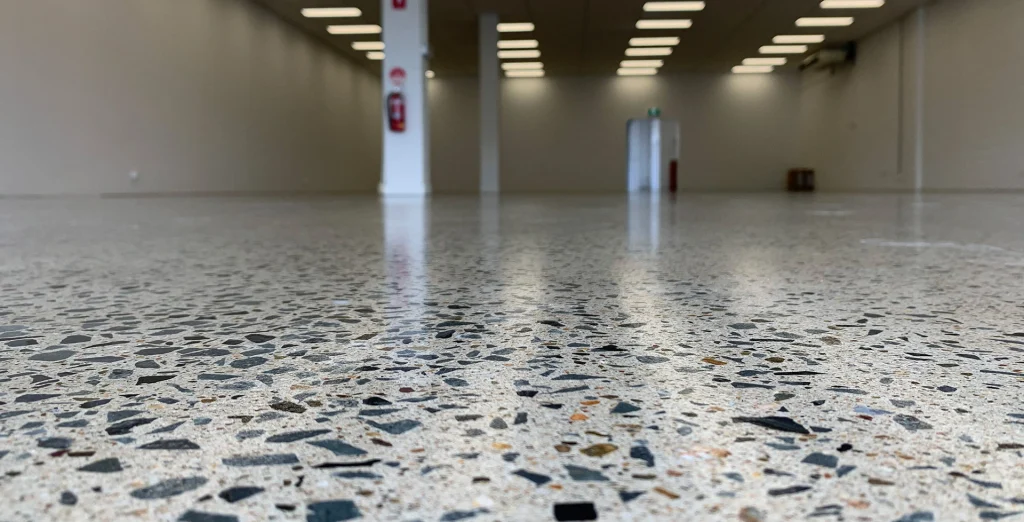
For a dry storage or distribution warehouse with a sound slab, polished concrete is usually the stronger long-term choice. It takes forklift traffic well, has no coating to peel, and needs very little maintenance. Epoxy is the better fit when your warehouse handles chemicals, oils, or washdowns, needs painted safety zones built into the floor, or sits on a worn slab that needs covering.
Upfront costs are close. Polished concrete in metro Atlanta typically runs about $3 to $8 per square foot, and warehouse epoxy runs about $3 to $10 per square foot depending on the system. Over time, polished concrete tends to cost less to own because it skips topcoat refreshes. Many facilities use both, with polished concrete in dry aisles and epoxy in maintenance bays or chemical storage.
Polished Concrete vs. Epoxy Warehouse Floors Side by Side
Here is how polished concrete vs. epoxy warehouse floors compare on the factors facility managers ask about most:
| Factor | Polished Concrete | Epoxy |
|---|---|---|
| How it works | Slab is diamond ground, densified, and polished | Resin coating bonds on top of the slab |
| Typical installed cost (metro Atlanta) | $3 to $8 per sq ft | $3 to $10 per sq ft |
| Forklift traffic | Excellent, nothing to chip or wear through | Very good with a high-build or heavy-duty system |
| Chemical and oil resistance | Limited, spills need quick cleanup | Strong sealed barrier |
| Slab moisture tolerance | High, the slab can breathe | Needs moisture testing and sometimes a mitigation primer |
| Color and safety striping | Stains and dyes, striping added separately | Full color options, zones and striping built in |
| Covers slab wear | Shows the character of the slab | Hides stains, patches, and uneven color |
| Long-term upkeep | Dust mopping and auto scrubbing | Topcoat refresh every 3 to 8 years, depending on traffic |
When Polished Concrete Is the Better Warehouse Floor
A polished concrete warehouse floor turns the slab you already own into the finished surface. The concrete is ground with progressively finer diamonds, hardened with a densifier, and polished to the sheen you choose. Since there is no film on top, forklift tires and pallet drags have nothing to wear through.
Polished concrete is usually the right call if your warehouse has:
- Dry storage or distribution traffic with forklifts, pallet jacks, and carts running all day
- A sound slab without major cracking, spalling, or heavy oil saturation
- Large square footage where lower maintenance adds up across every aisle
- Moisture in the slab that would make a coating harder to bond
- A need for brighter aisles, since a polished surface reflects overhead lighting back into the space
See our commercial polished concrete options to learn how finish levels and sheen are selected for warehouse use.
When Epoxy Is the Better Warehouse Floor
Epoxy warehouse flooring adds a sealed, seamless layer over the concrete. That layer is what gives epoxy its edge in spaces where liquids, chemicals, and visual safety cues matter. A high-build warehouse floor coating also evens out a slab that has seen years of patches and stains.
Epoxy is usually the right call if your warehouse has:
- Chemical, oil, or fluid exposure in maintenance bays, battery charging areas, or production zones
- Washdown or sanitation needs, where a nonporous surface cleans up faster
- Safety zones and walkways you want built into the floor with color coding and striping
- A worn or patched slab that looks better covered than polished
- Brand or appearance goals for customer-facing areas like will-call counters or showrooms
Heavy equipment areas call for thicker industrial epoxy flooring, and spill-prone zones benefit from chemical-resistant floor coatings matched to the specific fluids on site.
Cost Comparison: Upfront and Long Term
On cost, the two systems overlap more than most people expect. Polished concrete runs about $3 to $8 per square foot in metro Atlanta, depending on the level of polish and the condition of the slab. Warehouse epoxy runs about $3 to $7 per square foot for two-coat and standard systems and $6 to $10 per square foot for high-build systems, with heavy-duty and chemical-resistant builds priced higher.
The bigger difference shows up over the life of the floor:
- Polished concrete: Routine dust mopping and auto scrubbing keep it looking sharp. Some facilities schedule a periodic burnish or light repolish in high-traffic lanes.
- Epoxy: Daily care is simple, and the topcoat is typically refreshed every 3 to 8 years depending on traffic. A recoat costs far less than a full new system but does mean planning around downtime.
For a full breakdown of coating prices by system and square footage, see our guide to commercial epoxy flooring cost in Atlanta.
How Your Slab Condition Decides
Once you know how the warehouse is used, your slab condition settles most of the remaining questions. A walkthrough should check these four things before anyone recommends a system:
- Moisture: High moisture vapor readings favor polished concrete, or they add a mitigation primer to an epoxy scope.
- Cracks and spalls: Both systems start with concrete crack repair. Heavy damage tends to favor epoxy, since a coating covers repair patches that would show through a polish.
- Joints: Forklift wheels cross control joints all day. Proper control joint filling protects the joint edges on either floor and is one of the most important parts of a warehouse job.
- Existing coatings: Old paint, epoxy, or sealer has to come off before polishing, and usually before a new coating too. Old coating removal is often the step that reveals a slab ready for polishing.
The joints are where warehouse floors wear first. Protect the joints, and either system will serve you for years.
Using Both Systems in One Warehouse
You don’t have to pick one floor for the whole building. Using both systems in one warehouse is common: polished concrete goes in dry storage aisles and racking areas, and epoxy goes in maintenance shops, battery rooms, loading zones, and chemical storage. Each area gets the surface that fits its traffic and exposure.
A combined scope can also be scheduled in phases, so you keep part of the building running while another section is finished. For back-of-house areas that mainly need dust control, a grind and seal concrete finish is a smart, lighter option that stretches your budget across more square footage.
Warehouse Flooring FAQs
Is polished concrete or epoxy better for a warehouse?
For dry storage and distribution with a sound slab, polished concrete is usually the better long-term floor. For areas with chemicals, oils, washdowns, or built-in safety striping, epoxy is the better fit.
Does polished concrete hold up to forklift traffic?
Yes. Polished concrete handles forklift traffic very well because there is no coating to chip or wear through. Keeping the control joints filled and maintained protects the edges where wheels cross.
Which costs more, polished concrete or epoxy?
Upfront prices overlap. Polished concrete runs about $3 to $8 per square foot in metro Atlanta, and warehouse epoxy runs about $3 to $10 depending on the system. Polished concrete often costs less to own over time because it skips topcoat refreshes.
Can an existing warehouse slab be polished?
Most existing slabs can be polished, including older ones. Old coatings need to be removed first, and cracks or spalls are repaired during the process. A walkthrough confirms whether your slab is a good candidate.
Can you put epoxy in one area and polished concrete in another?
Yes, and many warehouses do. Polished concrete works well in dry aisles, while epoxy protects maintenance bays, battery charging areas, and chemical storage.
Find the Right Warehouse Floor for Your Facility
Buckhead Stone Care installs both polished concrete floors and warehouse epoxy systems, so your recommendation is based on your slab and how your space works every day. We serve warehouses and industrial facilities across Atlanta, Milton, and Athens, GA, plus nearby areas throughout metro Atlanta and Northeast Georgia.
Our crews bring experience with complex floors and large commercial slabs, and we stand behind our warranties. Local builders and contractors trust us on their projects, and we bring that same workmanship to every facility we finish.
Call 678-446-6560 or schedule a walkthrough to find the best floor for your warehouse.