
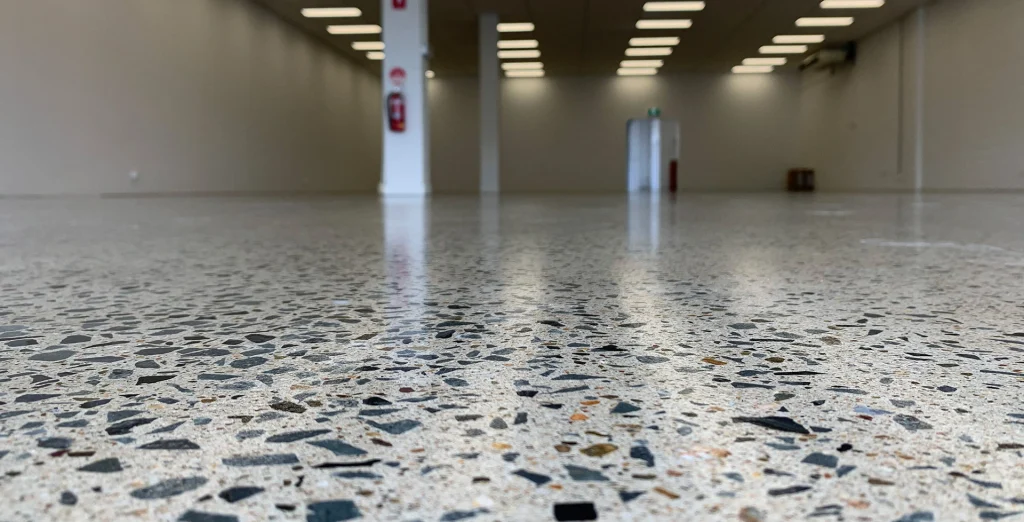
When comparing polished concrete vs epoxy warehouse floors, polished concrete is often the better choice for dry warehouses with heavy forklift traffic, while epoxy is usually better for facilities that need chemical resistance, spill protection, or a seamless coated surface. Both flooring systems offer durability, easy cleaning, and long term value, but they perform differently depending on how your warehouse operates.
For warehouses in Atlanta, GA, polished concrete generally costs around $3 to $8 per square foot, while commercial epoxy flooring can range from $3 to $10 per square foot for standard and high build systems. Specialized coatings may cost more.
Choosing between these options involves more than installation cost. You also need to consider forklift traffic, moisture, existing concrete damage, maintenance requirements, and potential business downtime.
At Buckhead Stone Care, we help commercial property owners and facility managers evaluate flooring options based on their building’s needs.
This guide compares polished concrete and epoxy warehouse flooring to help you determine which system is the better investment for your facility.
Polished Concrete vs Epoxy Warehouse Floors Comparison
Polished concrete and epoxy are both popular commercial flooring solutions, but they offer different advantages.
Polished concrete mechanically refines the existing slab, while epoxy creates a protective resinous coating over prepared concrete.
Here is how they compare.
| Feature | Polished Concrete | Epoxy Flooring |
|---|---|---|
| Estimated installed cost | $3 to $8 per sq ft | $3 to $10 per sq ft |
| Forklift traffic | Excellent on sound, properly maintained slabs | Excellent with an appropriately specified system |
| Chemical resistance | Limited compared with specialized coatings | Good to excellent, depending on product |
| Moisture considerations | Often more tolerant of slab moisture | Requires moisture evaluation |
| Appearance | Natural concrete finish | Solid colors or decorative finishes |
| Surface protection | Hardened concrete surface | Protective resinous coating |
| Maintenance | Routine cleaning and periodic polishing as needed | Routine cleaning and recoating as needed |
| Safety markings | Added separately | Can be integrated with coating applications |
| Concrete imperfections | May remain visible | Can visually cover prepared repairs |
| Best applications | Dry warehouses and distribution centers | Industrial areas with spills or specialized requirements |
Prices are approximate budgeting ranges. Actual installed costs vary based on floor condition, specifications, and project size.
The main difference is that polished concrete improves the existing slab, while epoxy adds a coating designed to provide specific surface protection.
Understanding this difference is important when selecting flooring for a warehouse or distribution facility.
What Is Polished Concrete for Warehouse Floors?
Polished concrete is a flooring system created by mechanically grinding, densifying, and polishing an existing concrete slab.
Instead of applying a thick surface coating, contractors use industrial diamond grinding equipment to refine the concrete.
The process typically includes:
- Grinding the concrete to remove surface imperfections and prepare the slab.
- Repairing suitable cracks and damaged areas.
- Applying a concrete densifier to improve surface hardness.
- Polishing the concrete with progressively finer diamond abrasives.
- Applying appropriate finishing treatments when required.
The result is a durable surface with a smooth finish that can range from low sheen to a more reflective appearance.
Because polished concrete uses the existing slab, it can be an economical option for warehouses with large floor areas.
Benefits of Polished Concrete Warehouse Floors
Durability Under Forklift Traffic
Properly installed polished concrete can withstand frequent forklift, pallet jack, and equipment traffic when the underlying slab is structurally suitable.
Unlike a film forming coating, polished concrete does not have a separate resin layer that can peel or delaminate.
However, the concrete itself can still experience damage from heavy impacts, abrasion, and joint deterioration.
Lower Maintenance Requirements
Polished concrete generally requires routine dust mopping and cleaning with appropriate products.
Periodic burnishing or repolishing may be needed in heavily used areas.
Improved Light Reflection
A polished surface can reflect overhead lighting, which may help improve visibility throughout warehouse aisles.
The amount of reflection depends on the finish and lighting conditions.
Long Term Value
Because polished concrete does not rely on a thick resinous topcoat, facilities may avoid some of the recoating expenses associated with epoxy systems.
Reduced Concrete Dusting
Proper grinding, densification, and polishing can reduce dusting compared with untreated, deteriorating concrete.
For more information about this flooring option, explore Buckhead Stone Care’s polished concrete services.
What Is Epoxy Warehouse Flooring?
Epoxy warehouse flooring is a resinous coating system installed over properly prepared concrete.
Epoxy coatings form a protective layer that can improve resistance to abrasion, chemicals, moisture exposure from above, and everyday industrial wear.
The installation process typically involves:
- Inspecting the concrete and evaluating moisture conditions.
- Grinding or shot blasting to create the required surface profile.
- Repairing damaged concrete and addressing joints.
- Applying the specified epoxy primer and coating layers.
- Adding aggregates, markings, or protective topcoats when required.
- Allowing the flooring system to cure before regular use.
Commercial epoxy systems are available in different thicknesses and formulations.
A basic warehouse coating may be suitable for dry storage, while a thicker industrial system may be needed for facilities exposed to demanding traffic or chemicals.
Benefits of Epoxy Warehouse Floors
Chemical Resistance
Certain epoxy coatings resist oils, chemicals, and cleaning products.
The level of resistance depends on the formulation and specific substances used within the facility.
Seamless Surface Protection
Epoxy creates a continuous coating that can make routine cleaning easier and help protect the concrete from spills.
Custom Colors and Safety Markings
Epoxy systems offer different color options for warehouse aisles, pedestrian areas, equipment zones, and designated workspaces.
Improved Appearance
A professionally installed epoxy floor can give older warehouses a more uniform appearance after appropriate surface preparation and repairs.
Specialized Industrial Performance
High build and heavy duty systems can be specified for equipment traffic, abrasion resistance, and demanding operating conditions.
Learn more about commercial flooring prices in our guide to commercial epoxy flooring cost in Atlanta.
Which Flooring Is Better for Heavy Forklift Traffic?
Forklift traffic is one of the most important considerations when comparing polished concrete vs epoxy warehouse floors.
Both systems can perform well, but the right choice depends on the concrete slab, equipment, and operating conditions.
Polished Concrete for Forklift Traffic
Polished concrete is often an excellent choice for dry distribution centers and warehouses with frequent forklift movement.
It does not have a separate coating film that can wear through or peel.
However, the slab must be suitable for the equipment loads, and concrete joints require proper maintenance.
Repeated forklift traffic can damage poorly maintained joints and slab edges.
Epoxy Flooring for Forklift Traffic
Industrial epoxy flooring can also withstand regular forklift operations when the correct system is installed.
The contractor should consider:
- Forklift weight and wheel type
- Frequency of equipment traffic
- Turning and braking areas
- Pallet jack usage
- Impact and abrasion exposure
- Condition of the concrete substrate
High build systems or specialized industrial coatings may be recommended for demanding applications.
For dry warehouses with structurally sound concrete, polished concrete is often a practical choice. For facilities that also require chemical protection or specialized surface performance, epoxy may be more appropriate.
Polished Concrete vs Epoxy Warehouse Flooring Cost
The upfront cost of polished concrete and epoxy often overlaps.
However, installation expenses depend on the existing slab, required finish, total square footage, and project specifications.
Polished Concrete Warehouse Flooring Cost
Polished concrete typically costs approximately $3 to $8 per square foot for many commercial projects.
The final price depends on:
- Concrete condition
- Amount of grinding required
- Desired polish level
- Repairs and joint treatment
- Existing coating removal
- Total floor area
Large warehouses with relatively sound concrete may fall toward the lower end of the estimated range.
Epoxy Warehouse Flooring Cost
Standard commercial epoxy flooring may cost approximately $3 to $7 per square foot, while high build systems can range from $6 to $10 per square foot.
Specialty systems may cost more.
The main pricing factors include coating thickness, surface preparation, moisture mitigation, repairs, and installation scheduling.
Warehouse Flooring Cost Comparison for 10,000 Square Feet
For a hypothetical warehouse with 10,000 square feet of floor space, estimated costs may look like this.
| Flooring System | Cost Per Sq Ft | Estimated Total |
|---|---|---|
| Polished concrete | $3 to $8 | $30,000 to $80,000 |
| Standard warehouse epoxy | $3 to $7 | $30,000 to $70,000 |
| High build industrial epoxy | $6 to $10 | $60,000 to $100,000 |
These figures are preliminary estimates rather than actual Buckhead Stone Care quotes. Major repairs, coating removal, moisture mitigation, and special scheduling may increase the final cost.
When evaluating proposals, compare the complete installation scope rather than choosing solely based on the lowest price.
Which Warehouse Floor Has Lower Maintenance Costs?
Polished concrete and epoxy flooring have different long term maintenance requirements.
Polished Concrete Maintenance
Polished concrete typically requires:
- Routine dust mopping
- Regular cleaning with suitable products
- Prompt spill cleanup
- Periodic inspection of joints and damaged areas
- Burnishing or repolishing when needed
Because the surface is mechanically refined concrete, it does not require the same type of resinous topcoat replacement as conventional epoxy flooring.
However, polished concrete can lose its shine in heavily trafficked areas and may require restoration.
Epoxy Flooring Maintenance
Epoxy warehouse floors typically require:
- Regular sweeping and cleaning
- Prompt removal of chemical spills
- Inspection for scratches and coating damage
- Maintenance of joints and traffic areas
- Periodic recoating when necessary
Heavy traffic, equipment turning, and exposure to harsh chemicals may accelerate coating wear.
Polished concrete often has lower long term maintenance costs in dry warehouse environments, while epoxy may offer better value when specialized chemical or spill protection is needed.
The correct comparison should consider both installation expenses and the expected maintenance requirements throughout the floor’s service life.
How Moisture Affects Polished Concrete and Epoxy Flooring
Concrete moisture is another important factor when selecting warehouse flooring.
Polished Concrete and Moisture
Polished concrete is often more tolerant of moisture vapor moving through a concrete slab than an impermeable coating system.
However, excessive moisture can still cause problems such as efflorescence, surface staining, and deterioration.
A professional evaluation is necessary when moisture issues are present.
Epoxy Flooring and Moisture
Epoxy coatings have specific moisture tolerance limits.
If moisture vapor exceeds those limits, the coating may experience blistering, delamination, or other performance problems.
Before installing epoxy, contractors may recommend moisture testing and, when necessary, a compatible mitigation system.
For facilities with known moisture problems, determining the cause and selecting an appropriate flooring system is essential.
Can You Install Epoxy Over Damaged Warehouse Concrete?
Epoxy may be installed over an older concrete slab after appropriate evaluation and repairs.
However, applying epoxy does not fix underlying structural damage.
Cracks, spalling, weakened surfaces, and damaged joints may require professional repair before installation.
Similarly, polished concrete does not eliminate existing structural problems.
Some cracks and repair patches may remain visible after polishing.
The appropriate solution depends on the extent of damage and the performance requirements of the facility.
Buckhead Stone Care offers floor preparation and leveling services to help prepare concrete surfaces for flooring installations.
For additional technical information about concrete preparation, visit the International Concrete Repair Institute.
Is Polished Concrete or Epoxy Safer for Warehouses?
Warehouse floor safety depends on more than the flooring material.
Factors such as surface texture, contaminants, cleaning practices, and traffic patterns all influence slip resistance.
Slip Resistance
Polished concrete can provide suitable traction in dry environments when properly finished and maintained.
However, wet or contaminated surfaces may become slippery.
Epoxy flooring can incorporate textured aggregates or other additives to improve traction.
The amount of texture should match the operating environment and cleaning requirements.
Safety Markings
Epoxy systems can be installed in different colors to identify pedestrian walkways, equipment zones, and designated work areas.
Polished concrete can also use applied safety striping, although those markings may require separate maintenance.
Facility managers should evaluate slip resistance and safety marking requirements based on actual operations.
Can You Combine Polished Concrete and Epoxy in One Warehouse?
Yes. Many commercial facilities benefit from using different flooring systems in different areas.
For example, a large distribution center may use polished concrete in dry storage aisles and epoxy in areas exposed to spills or chemicals.
| Warehouse Area | Potential Flooring Choice |
|---|---|
| Dry storage aisles | Polished concrete |
| Distribution areas | Polished concrete |
| Maintenance bays | Chemical resistant epoxy |
| Equipment service zones | Industrial epoxy |
| Chemical storage areas | Compatible protective coating |
| Customer facing areas | Polished or decorative epoxy |
| Light duty storage | Polished concrete or grind and seal |
Battery charging areas, chemical storage spaces, and other specialized environments may require additional performance specifications that go beyond standard epoxy.
For warehouse areas that mainly need dust control and easier cleaning, a grind and seal concrete system may also be worth considering.
Combining different systems can help businesses balance installation costs, maintenance, and performance throughout the facility.
How to Choose the Right Warehouse Flooring in Atlanta GA
Choosing between polished concrete and epoxy starts with understanding how your warehouse operates.
Before selecting a flooring system, consider the following questions.
What type of equipment operates in the facility?
Forklift weights, wheel types, and traffic patterns help determine the appropriate surface.
Does the floor experience chemical spills or frequent washdowns?
Facilities exposed to chemicals or liquids may require a compatible protective coating.
What condition is the concrete slab in?
Cracks, repairs, moisture, existing coatings, and surface contamination affect installation options.
How important is long term maintenance?
Polished concrete may reduce certain maintenance expenses, while epoxy may offer greater protection in specialized environments.
Will installation affect business operations?
Consider curing requirements, equipment access, phased installation, and facility downtime.
What is your flooring budget?
Compare not only installation costs but also expected cleaning, repairs, and future maintenance.
At Buckhead Stone Care, we evaluate these factors to help businesses choose the right concrete flooring solution.
Polished Concrete vs Epoxy Warehouse Floors FAQs
Is Polished Concrete or Epoxy Better for a Warehouse?
Polished concrete is often better for dry warehouses with sound concrete and frequent forklift traffic. Epoxy is generally better for facilities that need chemical resistance, seamless surface protection, or specialized industrial performance.
Does Polished Concrete Hold Up to Forklift Traffic?
Yes. Properly installed polished concrete can withstand regular forklift traffic when the slab is suitable for the equipment loads. Maintaining control joints and repairing damaged areas helps preserve the floor.
Is Polished Concrete Cheaper Than Epoxy?
Polished concrete often costs approximately $3 to $8 per square foot, while standard and high build commercial epoxy systems may range from $3 to $10 per square foot. Total costs depend on the system and surface preparation. Polished concrete may have lower maintenance expenses in certain applications.
How Long Does Polished Concrete Last in a Warehouse?
A polished concrete floor can provide many years or decades of service when the underlying slab is sound and properly maintained. Heavy traffic, spills, and poor joint maintenance can shorten the useful life of the finish.
How Long Does Epoxy Warehouse Flooring Last?
Commercial epoxy can last many years when properly specified and installed. However, service life varies with coating thickness, equipment traffic, chemical exposure, and maintenance. Heavily used areas may require recoating sooner than light duty spaces.
Can You Polish an Existing Warehouse Concrete Floor?
Many existing concrete slabs can be polished after appropriate preparation. However, severe deterioration, contamination, unsuitable repairs, or structural problems can make polishing impractical. A professional inspection helps determine suitability.
Which Flooring Is Better for Chemical Storage Areas?
A chemically resistant flooring system is generally preferable to polished concrete for areas exposed to frequent chemical spills. The selected product must be compatible with the specific chemicals and concentrations present.
Is Polished Concrete Slippery for Warehouse Workers?
Polished concrete is not automatically slippery, but traction depends on finish, cleaning, moisture, and contaminants. Warehouse areas exposed to liquids may require additional safety measures or a textured flooring system.
Can You Use Polished Concrete and Epoxy in the Same Warehouse?
Yes. Polished concrete can be used in dry storage and distribution aisles, while appropriately specified epoxy systems can protect maintenance areas and other spaces exposed to spills.
Which Warehouse Flooring Requires Less Maintenance?
Polished concrete generally requires routine cleaning and occasional surface restoration. Epoxy also requires regular cleaning but may need periodic recoating. The lower maintenance option depends on the facility’s traffic and operating conditions.
Get Professional Warehouse Flooring in Atlanta GA
Choosing between polished concrete vs epoxy warehouse floors depends on your facility’s operations, concrete condition, maintenance needs, and budget.
Polished concrete is often a practical choice for large dry warehouses that need a durable, low maintenance surface.
Epoxy flooring may be the better investment for facilities requiring chemical resistance, decorative finishes, or specialized industrial protection.
At Buckhead Stone Care, we help warehouse owners, facility managers, builders, and general contractors select concrete flooring solutions based on their project requirements.
Our team serves commercial and industrial properties throughout Atlanta, Milton, Athens, and surrounding areas in Georgia.
We focus on proper concrete preparation, quality workmanship, and flooring systems designed to support daily operations.
Explore our completed concrete flooring projects to learn more about our work.
Ready to upgrade your warehouse flooring?
Call 678-446-6560 or contact Buckhead Stone Care to request a warehouse flooring evaluation and a detailed project estimate.